English
 中文简体
中文简体 Español
 svenska



Content
Why Your Lawn Mower Belt Keeps Coming Off — and How to Fix It for Good
A lawn mower belt that keeps coming off is one of the most frustrating recurring problems for homeowners — and one of the most misdiagnosed. Most people replace the belt, find it slips off again within hours, and assume they got a defective part. In nearly every case, the belt itself is not the problem.
The Most Common Causes
- Worn or damaged pulleys: Inspect every pulley the belt contacts. A pulley with a worn groove, flat spot, or wobble will throw the belt off consistently. Spin each pulley by hand — any roughness, lateral wobble, or resistance indicates a bearing failure. Replace the pulley, not just the belt.
- Bent pulley bracket: After striking a hidden obstacle, the bracket mounting a deck pulley can bend just enough to misalign the belt path. Visually sight down the belt line with the belt installed — all pulleys should sit in the same plane.
- Wrong belt size: An aftermarket belt that is even ¼ inch too long will not maintain tension and will walk off under load. Always verify the OEM part number or cross-reference the exact length and width specifications from the deck label.
- Worn or seized belt keeper/guide: Most decks use small metal fingers (keepers) positioned just outside the belt path to catch the belt if it wanders. If these are bent outward or missing, the belt has no backstop. Bend them back to within 1/8 inch of the belt surface.
- Weak or broken idler spring: The idler pulley maintains belt tension via a spring. A stretched or broken spring reduces tension, allowing the belt to slip off during engagement or under sudden load changes. Springs are inexpensive; replace if the free length has decreased noticeably.
- Debris accumulation: Grass clippings and dirt packed around pulleys and inside the belt channel act as a wedge, lifting the belt out of the groove. Clean the entire deck thoroughly before diagnosing mechanical causes.
The diagnostic sequence should always go: clean the deck → inspect all pulleys → check belt keepers → verify belt dimensions → test idler spring tension. Replacing the belt without completing this sequence virtually guarantees the problem recurs.
Lawn Mower Pull Cord Replacement: A Step-by-Step Guide
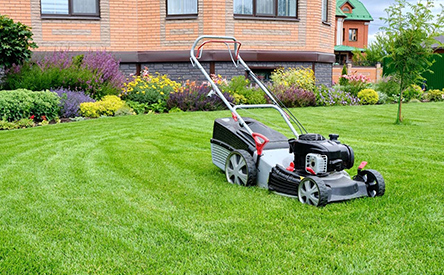
A broken or frayed lawn mower pull cord is one of the most straightforward repairs you can complete at home in under 30 minutes with basic tools. The recoil starter assembly is largely standardized across brands — the process below applies to the vast majority of walk-behind mowers.
What You Need
- Replacement starter rope — #4 (3/16") diameter is standard for most walk-behind mowers; #4.5 or #5 suits larger engines. Match the original length exactly, or measure the old cord plus 12 inches.
- Flathead and Phillips screwdrivers
- Needle-nose pliers
- A lighter or matches (to seal the cut end of the rope)
Replacement Procedure
- Remove the recoil starter cover (typically 3–4 bolts on top of the engine shroud).
- Note how many turns of spring preload exist before disassembly — pull the rope out fully, hold the pulley, and count the clicks as you let the spring rewind. Note this number.
- Remove the old rope: untie or cut the knot at the pulley, and pull the handle end through the housing eyelet.
- Thread the new rope: pass one end through the housing eyelet (from outside inward), then through the pulley slot. Tie a figure-eight or overhand knot — it must be large enough not to pull through the slot.
- Melt the rope end with a lighter to prevent fraying immediately after cutting.
- Wind the preload: rotate the pulley the same number of turns noted in step 2, in the direction that tensions the spring (opposite to pull direction). Hold the pulley under tension.
- Thread the rope through the housing eyelet and attach the handle. Release the pulley slowly — the spring should rewind the rope smoothly.
- Test pull several times before reinstalling the cover.
If the rope rewinds sluggishly or not at all after replacement, the recoil spring itself is likely broken or unhooked — a common companion failure. Recoil spring kits are available for under $10 for most mower models.
Lawn Mower Pull Cord Hard to Pull: Diagnosing the Real Cause
When a lawn mower pull cord is hard to pull, most owners assume the engine has seized — and in rare cases that is true. But the majority of hard-pull complaints have simpler, fully reversible causes. Work through these in order before concluding the engine has catastrophic damage.
Hydraulic Lock (Most Common Cause)
If a mower was stored on its side, tipped to clear a clog, or has a leaking head gasket, engine oil can migrate into the combustion chamber. The cord becomes nearly impossible to pull because liquid cannot be compressed. Fix: Remove the spark plug, point the plug hole away from yourself and bystanders, then slowly pull the cord. Oil will discharge from the plug hole. Wipe the bore, install a fresh plug, and the engine should pull freely and start normally.
Blade Strike and Bent Crankshaft
Hitting a solid object at speed can bend the crankshaft even slightly. Because the blade is mounted directly to the crankshaft on most walk-behind mowers, a bent shaft causes the blade to wobble and drag against the deck with every rotation, creating enormous resistance. Remove the spark plug wire, tip the mower (carburetor side up), and try rotating the blade by hand. Any wobble in the blade or roughness in the rotation indicates a bent crankshaft — a condition that typically requires professional repair or engine replacement.
Other Causes to Check
- Recoil spring tangled: The spring inside the starter housing can overlap itself if the rope was pulled too hard during a failed start. Remove the housing and inspect.
- Excessive compression: Some engines have a compression release valve that opens at low RPM to reduce pull force. If this valve is stuck closed, the rope will be very hard to pull but the engine itself is fine. Clean or replace the compression release.
- Wrong oil viscosity in cold weather: Thick winter oil (30W vs. 5W-30) dramatically increases cranking resistance below 40°F. Switch to the weight specified in the owner's manual for your temperature range.
- Debris under the deck: Packed clippings or a stick wedged against the blade prevent rotation entirely. Always check and clear the underside before assuming internal engine failure.
How to Test the Coil on a Lawn Mower
The ignition coil (also called the armature or magneto) generates the high-voltage pulse that fires the spark plug. A faulty coil produces symptoms that closely mimic carburetor problems — the engine cranks, may briefly fire, then dies — making it one of the most commonly misdiagnosed faults. Testing the coil on a lawn mower requires only a basic multimeter and takes about 10 minutes.
Method 1: Spark Test (No Tools Required)
This test confirms whether the coil produces any spark at all, but cannot reveal a weak or intermittent coil.
- Remove the spark plug and reconnect it to the plug wire.
- Hold the plug threads against a bare metal surface on the engine block (or use an inline spark tester).
- Pull the starter cord briskly. A healthy coil produces a strong blue spark. A yellow or orange spark — or no spark — indicates a weak or failed coil.
Method 2: Resistance Test with a Multimeter
This method provides a quantitative measurement to confirm coil failure definitively. Set your multimeter to the ohms (Ω) setting.
- Disconnect the kill wire (usually a single wire with a spade connector) from the coil — a grounded kill wire will mimic a dead coil and cause a false failure reading.
- Primary winding test: Place one probe on the coil's laminated iron core and the other on the kill wire terminal. Most small engine coils read 0.5–2.5 ohms on the primary winding. A reading of zero (short circuit) or OL/infinite (open circuit) confirms coil failure.
- Secondary winding test: Place one probe on the coil core and the other inside the spark plug boot (contact the metal terminal inside). Secondary resistance typically reads 2.5–5 kΩ (2,500–5,000 ohms). Again, zero or infinite resistance indicates failure.
- Compare your readings against the service manual specification for your engine model — values vary between manufacturers. Briggs & Stratton, Honda, and Kawasaki all publish free specs online.
Important: Heat-Related Coil Failure
A coil that tests within spec when cold but fails under operating temperature is a classic failure pattern. If your mower starts cold, runs for 10–20 minutes, then dies and refuses to restart until it cools down — suspect a heat-failing coil even if the cold resistance test passes. The only reliable test in this scenario is an inline spark tester observed while the engine is at operating temperature immediately after it stalls.
| Test | Tool Needed | Healthy Reading | Fail Indicator |
|---|---|---|---|
| Spark test | None / spark tester | Strong blue spark | Weak/yellow spark or no spark |
| Primary resistance | Multimeter (ohms) | 0.5 – 2.5 Ω | 0 Ω or OL (infinite) |
| Secondary resistance | Multimeter (ohms) | 2,500 – 5,000 Ω | 0 Ω or OL (infinite) |
| Hot/cold comparison | Inline spark tester | Consistent spark hot and cold | Spark lost only when hot |
Coil air gap adjustment is a frequently overlooked step after coil replacement. The gap between the coil's magnetic legs and the flywheel magnets must be set precisely — typically 0.006–0.010 inches (a standard business card is approximately 0.010"). Too wide a gap reduces spark energy; too narrow risks physical contact and coil destruction. Insert the feeler gauge or card between the coil and flywheel, snug the coil mounting bolts, then remove the gauge and rotate the flywheel to verify clearance.