English
 中文简体
中文简体 Español
 svenska



Content
- 1 The Fundamental Job of an Idler Pulley: Tension, Routing, and Wrap Angle Control
- 2 Why Belt Tension and Routing Accuracy Matter for System Efficiency
- 3 Lawn Mower Idler Pulleys: The Deck Belt Component That Determines Cut Quality
- 4 What Do Idler Pulleys Do When They Fail? Recognizable Symptoms and Timelines
- 5 Idler Pulley vs. Tensioner Pulley: Two Components with Distinct Functions
- 6 Material and Bearing Quality: What Defines a Long-Lasting Idler Pulley
The Fundamental Job of an Idler Pulley: Tension, Routing, and Wrap Angle Control
An idler pulley is a free-spinning wheel that guides, tensions, or redirects a drive belt without transmitting power itself. It does not have a driven shaft connected to a pump, alternator, or mower blade. Instead, it presses against the smooth back side of a V-belt or serpentine belt to increase the wrap angle around adjacent driven pulleys, which directly raises the amount of torque that can be transferred before the belt slips. The force applied by an idler pulley on a belt is typically set between 45 and 90 newtons for automotive serpentine belts, and similar principles apply to lawn and garden equipment.
In practice, idler pulleys solve a geometric problem. A belt routed directly between two pulleys may only achieve a 90-degree wrap on the smaller pulley, which is often insufficient to prevent slip under load. Adding an idler increases that wrap to 120–180 degrees, effectively doubling the torque capacity of the connection without increasing belt tension beyond design limits. The idler bearing is the only component that wears significantly, and its failure mode is predictable: noise, heat, and eventual seizure.
Why Belt Tension and Routing Accuracy Matter for System Efficiency
When an idler pulley maintains correct belt tension, the belt transmits power with minimal energy loss. Loose belts caused by a failing idler slip and convert mechanical energy into heat. In automotive accessory drives, a slip rate of just 2–3% can raise the belt temperature by 30–40°C and reduce alternator output enough to cause charging system warnings. On a lawn mower, the consequences are even more immediate because the mower deck belt depends on consistent tension to maintain blade speed.
The data below compares belt efficiency and component stress under different idler pulley conditions in a typical multi-groove serpentine drive.
| Idler Condition | Belt Tension (N) | Torque Transfer Efficiency | Bearing Operating Temp (°C) |
|---|---|---|---|
| Properly tensioned, new idler | 70–85 | 97–98% | 50–65 |
| Worn bearing, smooth rotation | 60–70 | 92–95% | 70–85 |
| Sticking or seized idler | Variable, below 50 | Below 85% | Above 100 |
These numbers make it clear: what idler pulleys do is convert a static geometric layout into a stable dynamic system. When the idler can no longer keep the belt seated at the design tension, the entire driven system loses capacity long before the belt itself fails.
Lawn Mower Idler Pulleys: The Deck Belt Component That Determines Cut Quality
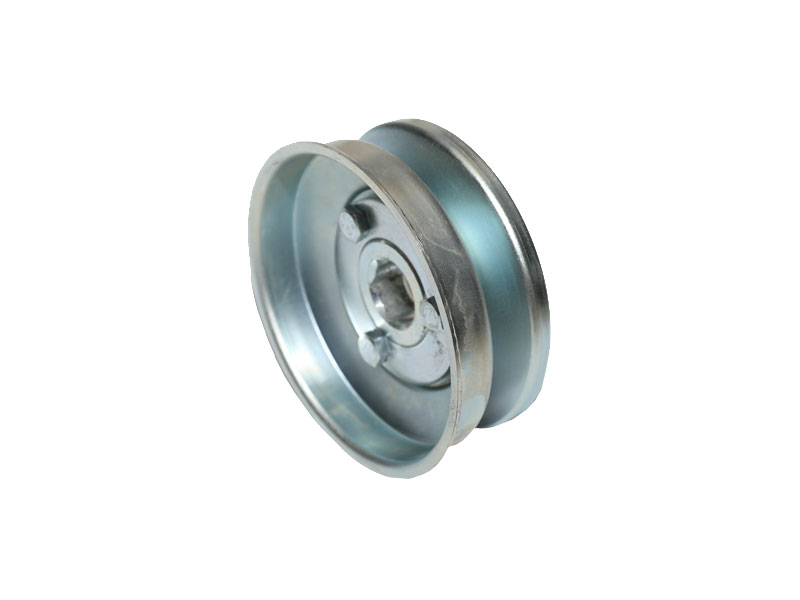
A pulley lawn mower deck uses idler pulleys in a more demanding environment than almost any automotive application. The mower deck belt must drive multiple blades at high speed while contending with grass debris, moisture, shock loads from hitting obstacles, and frequent engagement and disengagement cycles. The idler pulleys on a residential riding mower deck maintain belt tension as the blades are engaged via the PTO clutch and ensure each blade pulley receives consistent torque even when cutting through heavy or wet grass.
On a typical 42- or 48-inch riding mower deck, there are usually two to three idler pulleys: one flat idler that presses on the back of the belt to maintain tension, and one or more V-groove idlers that guide the belt around sharp corners. A single flat idler pulley with an integrated arm and spring applies the baseline tension, which for most consumer-grade mower decks falls in the range of 15–25 foot-pounds measured at the idler arm. If that spring weakens or the pulley bearing begins to drag, blade tip speed drops. A reduction of only 200–300 RPM at the blade tips can leave uncut strips and clumps, the first visible symptom that an idler pulley is not doing its job.
The pulley lawn mower idler also absorbs the shock of blade engagement. Every time the PTO is engaged, the belt is suddenly loaded and the idler pulley arm moves through a short arc as the belt tightens. The bearing in that idler undergoes a rapid acceleration from zero to over 3,000 RPM in less than a second, which is why OEM idlers are built with high-speed, sealed ball bearings rather than bushings.
What Do Idler Pulleys Do When They Fail? Recognizable Symptoms and Timelines
Idler pulley failures follow a predictable progression. The bearing, which is a permanently lubricated sealed unit, loses grease gradually through heat cycling and contamination. Once the grease breaks down or enough moisture enters, the bearing goes through four distinct stages, each with a clear external symptom.
- Stage one — intermittent chirp: On cold start, a brief squeak or chirp lasts for a few seconds until the bearing warms and redistributes remaining grease. This can continue for 20–40 operating hours before progressing.
- Stage two — constant squeal: The noise becomes continuous once the engine or deck is running. The belt may start to show glaze on its back side, indicating friction between the belt and a pulley that is not turning freely.
- Stage three — visible wobble and belt dust: Bearing play allows the pulley to tilt slightly. Black rubber dust accumulates around the idler bracket. This is often the last warning before belt derailment.
- Stage four — seizure and belt destruction: The bearing locks, the idler becomes a fixed pin, and the belt is dragged over a stationary surface. A serpentine or deck belt can be torn apart in under 3 seconds at full engine RPM.
On a pulley lawn mower deck, stage four is particularly dangerous because a thrown belt can damage the PTO wiring harness or the deck shell itself. Replacement of a seized idler and the destroyed belt typically costs 3–5 times more than replacing a noisy idler at stage one. The idler pulley is the cheapest wear item in the belt path, and its prompt replacement is the most cost-effective maintenance decision in the entire drive system.
Idler Pulley vs. Tensioner Pulley: Two Components with Distinct Functions
The terms "idler pulley" and "tensioner pulley" are frequently used interchangeably, but they refer to different parts with different mechanical roles. Understanding the distinction helps when diagnosing noise or ordering replacements. The table below clarifies the differences.
| Feature | Idler Pulley | Tensioner Pulley |
|---|---|---|
| Mounting | Fixed bracket or manual adjustment slot | Spring-loaded arm or automatic hydraulic actuator |
| Tension adjustment | Set during installation, static | Automatically compensates for belt stretch and thermal expansion |
| Primary function | Increase wrap angle, guide routing | Maintain constant belt tension |
| Typical replacement interval | 60,000–100,000 miles (auto); 400–600 hours (mower) | 60,000–100,000 miles (replace complete assembly) |
On many engines, the tensioner assembly includes a pulley that looks identical to a fixed idler, but the assembly moves as a unit. For a pulley lawn mower deck, the spring-loaded idler arm functions as a simple tensioner, and the pulley on that arm is technically the tensioner pulley. When ordering replacement parts, searching by the specific mower model number avoids confusion between fixed idlers and tensioner arm pulleys.
Material and Bearing Quality: What Defines a Long-Lasting Idler Pulley
The difference between an OEM idler pulley that lasts a decade and an aftermarket unit that fails within a single season comes down to the bearing and the pulley material. The pulley body is typically either stamped steel, cast iron, or glass-reinforced nylon. Steel pulleys resist stone impact and heat but can rust if the coating is damaged. Nylon pulleys are lighter and never rust, which is an advantage on mower decks that are frequently wet. However, nylon loses strength above approximately 120°C, so it is unsuitable for under-hood automotive use near the exhaust manifold.
The bearing is the heart of the idler. A quality idler uses a double-sealed, deep-groove ball bearing with an ABEC-1 or ABEC-3 tolerance class and a grease fill rated for temperatures of −40°C to 150°C. The seal type is critical: a contact rubber seal (designated 2RS) offers better contamination resistance than a metal shield (designated ZZ) and is preferred for lawn and garden equipment that operates in dusty, wet environments. The bearing's dynamic load rating for a typical flat idler of 70–90 mm diameter should be at least 8 kN to handle the combined radial load from belt tension and the lateral forces of misalignment during deck flex.
On a pulley lawn mower, the center bolt that secures the idler is under constant vibration and should be checked for torque during routine blade maintenance. A loose idler bolt allows the entire pulley to tilt, which wears the bearing unevenly and can cut the service life of both the bearing and the belt by more than half.